The E-commerce Seller's Guide to United States Shipping Label Formats: USPS, UPS, and FedEx
For any e-commerce business operating within the United States, you’ll find the shipping label is the single most important document in the fulfillment process. It’s the package’s passport, its GPS, and its ID card, all rolled into one.
While the concept of a shipping label seems straightforward, the reality is that each major US carrier—the United States Postal Service (USPS), United Parcel Service (UPS), and FedEx—has its own specific formatting requirements and data elements. Interestingly, creating a label that is not compliant with your chosen carrier’s system can lead to sorting delays, returned packages, and costly surcharges. This guide will demystify the label formats of the top US carriers, helping you understand the key components and ensure every package you send is primed for a smooth, efficient journey from your door to your customer’s.
The Universal Anatomy of a US Shipping Label
Despite minor layout differences, you’ll notice all compliant US shipping labels share a core anatomy designed for maximum efficiency in a highly automated logistics network. Understanding these universal components is the first step to creating perfect labels every time.
- Sender and Recipient Addresses:
This is the most basic and crucial information. The sender's (your) address is vital for returns, while the recipient's address must be 100% accurate, including the full street address, city, state, and, most importantly, the full ZIP+4 code (e.g., 90210-1234) for precise automated sorting.
- The Tracking Barcode and Number:
This is the heart of the label. A unique barcode (typically a Code 128 symbology) is generated for each shipment. This code is scanned at every point in the package’s journey, providing the real-time tracking data that customers expect. The human-readable tracking number is printed directly above or below it.
- The MaxiCode (Unique to UPS):
You’ll notice a distinctive, circular, bullseye-like symbol on all UPS labels. This is a MaxiCode, a 2D barcode that encodes a wealth of data, including the destination address, service level, and tracking number. It’s highly damage-resistant and can be scanned at incredible speeds, making it a cornerstone of UPS’s automated sorting process.
- The Service Level Indicator:
This clearly states the shipping service that has been paid for (e.g., 'USPS PRIORITY MAIL 2-DAY', 'UPS GROUND', 'FEDEX HOME DELIVERY'). This is critical for both courier employees and automated systems to route the package correctly.
- Routing and Sorting Information:
This often includes a large, bold set of letters or numbers indicating the destination hub or sorting zone. For USPS, you’ll often see a 'POSTNET' barcode representing the ZIP code. For UPS and FedEx, you’ll see proprietary routing codes. These elements are designed for rapid visual and machine sorting.
- Package Weight and Dimensions:
The declared weight of the package is a key factor in calculating the shipping cost. Inaccurate declarations can lead to billing adjustments and penalties.
Carrier-Specific Deep Dive: USPS, UPS, and FedEx
1. USPS Shipping Labels
As the national postal service, USPS is often the most cost-effective option for small, lightweight packages, making it a favorite for many e-commerce startups. Their labels have some unique features.
- Focus on Automation:
USPS labels are heavily optimized for their massive, nationwide automated sorting network. The 'Intelligent Mail Barcode' (IMb) and POSTNET barcode are key features that encode the destination ZIP code for high-speed machine sorting.
- The USPS Logo and Service Banner:
Every official USPS label prominently features the USPS eagle logo and a clear banner indicating the service class (e.g., PRIORITY MAIL, FIRST-CLASS PACKAGE).
- Electronic Postage:
A compliant USPS label must include a digital postage indicia, often a 2D data matrix code, which proves that postage for the specific weight and destination has been paid for. You can't simply print an address and a tracking barcode; the postage must be digitally embedded in the label. This is why using an authorized PC Postage provider or a shipping software that integrates with USPS is essential. A simple online shipping label generator can handle this automatically.
2. UPS Shipping Labels
UPS is a global logistics powerhouse known for its reliability and detailed tracking, making it a popular choice for higher-value goods and business-to-business shipments.
- The MaxiCode is King:
The most distinctive feature of a UPS label is the bullseye-shaped MaxiCode. This 2D code is incredibly robust and contains redundant data, meaning it can often be read even if a portion of it is damaged or smudged. It's a key part of what makes the UPS sorting system so efficient.
- Proprietary Tracking Format:
UPS tracking numbers typically start with '1Z' followed by a 16-digit alphanumeric string. This format is unique to UPS.
- Detailed Service Level Blocks:
A UPS label has very clear, boxed-off sections that denote the service level (GROUND, 2ND DAY AIR, etc.) and any special handling instructions.
3. FedEx Shipping Labels
FedEx is renowned for its speed and express delivery services, making it a go-to for time-sensitive and international shipments.
- The FedEx Barcode:
Like the others, FedEx uses a primary Code 128 tracking barcode, but their labels often include secondary barcodes for internal routing or service information.
- Prominent Branding:
FedEx labels feature strong, clear branding with the iconic purple and orange logo, making them instantly recognizable.
- Service-Specific Naming:
FedEx has distinct service names that are clearly printed on the label, such as 'FedEx Express', 'FedEx Ground', and 'FedEx Home Delivery' (for residential addresses).
The Critical Importance of Using an Approved Label Generator
Given the specific and complex requirements of each carrier, it is practically impossible and highly inadvisable to try and create a shipping label from scratch using a design program. You must use a software solution that is authorized by the carriers to generate compliant labels. This could be:
- The Carrier's Own Website:
You can generate labels directly on USPS.com, UPS.com, or FedEx.com, but this is a slow, manual process that is not scalable for an e-commerce business.
- Multi-Carrier Shipping Software:
Platforms like ShipStation, Pirate Ship, or Shippo are designed for e-commerce. They integrate directly with your store and with all the major carriers, allowing you to compare rates and print compliant labels in bulk.
- A Free Online Label Generator:
For smaller sellers or those needing to create a one-off label without a full software subscription, a tool like SmartLabelPrint.com is ideal. It provides a simple interface to enter address details and generates a standardized label format that incorporates the essential elements needed for shipping. While it may not connect directly to a carrier for postage, it produces a perfectly formatted address label that can be used in various contexts. For a better understanding of how label printers work with these formats, see our article on why professional label printing is non-negotiable.
Printing Best Practices for US Carriers
Creating a perfect digital label is only half the job. Proper printing is essential for ensuring scannability.
- Standard Size:
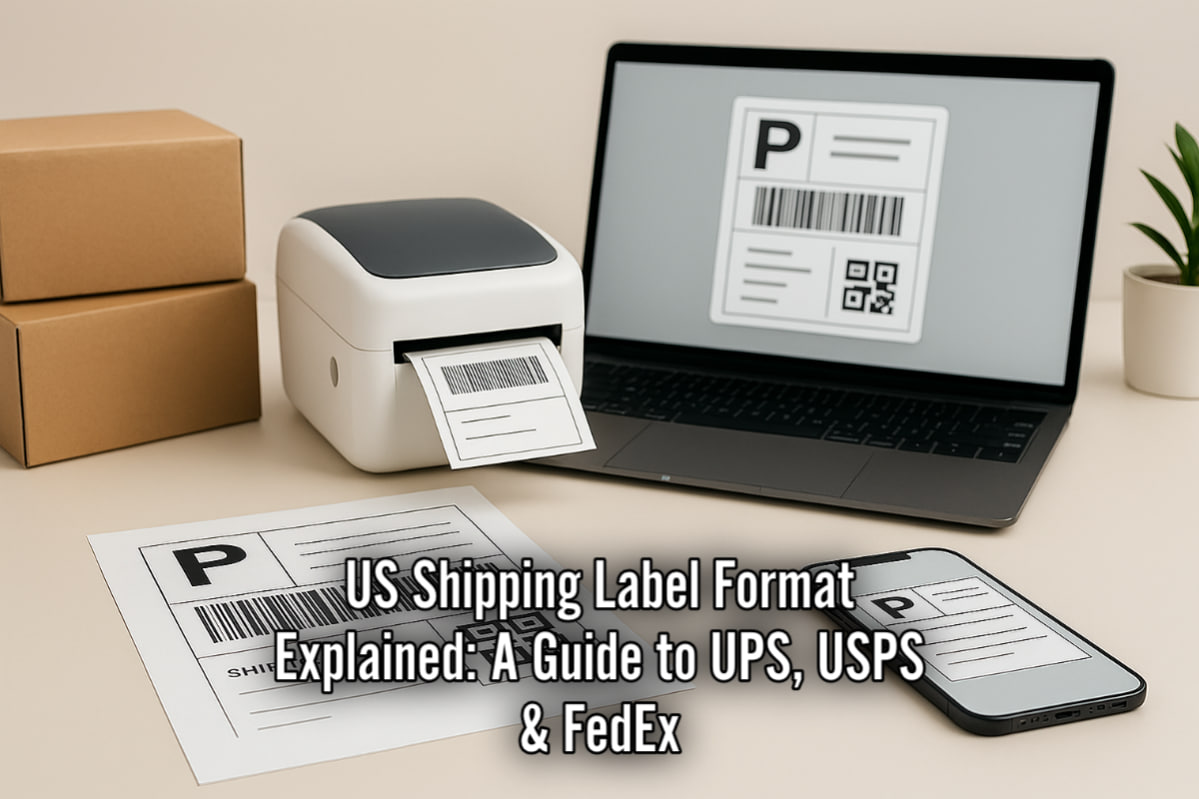
The de facto standard size for all major US carriers is a 4x6 inch thermal label. While you can print on half-sheet A4 or US Letter paper, a 4x6 thermal printer is the professional standard for efficiency and cost-effectiveness.
- The Golden Rule of Printing:
When printing your PDF label, always ensure your printer settings are set to '100% Scale' or 'Actual Size.' Never use 'Fit to Page.' This will distort the barcode and risk scanning failures.
By understanding the unique formats of USPS, UPS, and FedEx, and by using an approved software solution to generate your labels, you ensure that every package you send is equipped with the precise data and formatting it needs to navigate the complex US logistics network with speed and accuracy. This attention to detail is a hallmark of a professional e-commerce operation and a key ingredient for long-term success.